.svg)
.svg)
Discover .humanoid
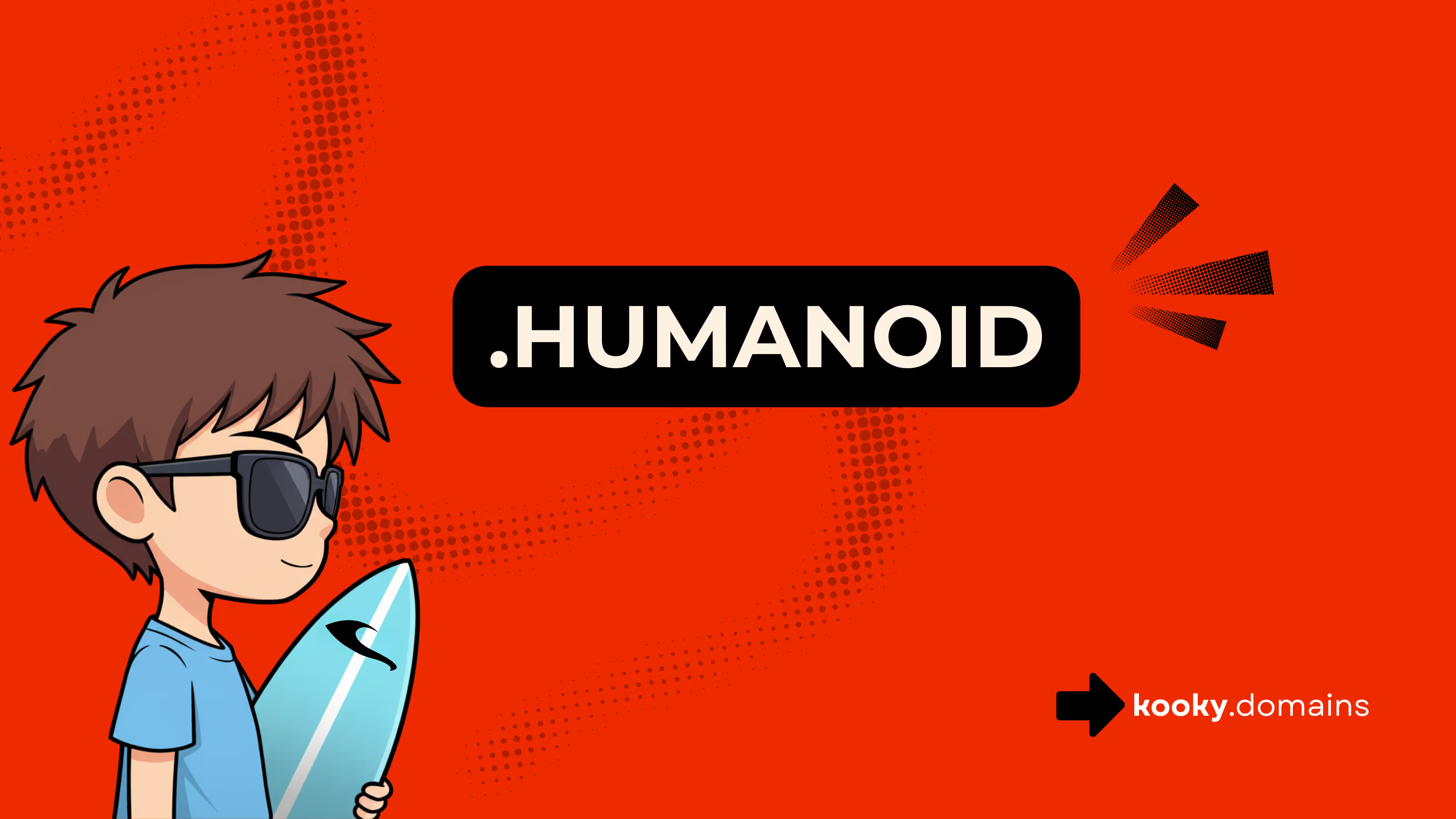
People talk about god mode like a cheat code, but in a post-human world it looks like identity control. When bodies, bots, and blended selves all show up online, your name stops being a label and starts acting like a key.
God Mode: Post-Human Edition is about that shift in plain words. It's about post-human identity (what you can prove, carry, and keep), why names matter when everything moves fast, and why ownership beats permission when you're building a life across apps, chains, and communities.
That's where onchain domains come in. Instead of renting a name and hoping it doesn't expire, you buy once and hold it in your wallet as an asset, so it can follow you anywhere you go. What changes when your identity can't be quietly taken, canceled, or "forgotten," and you can move it as easily as you move funds?
Kooky Domains puts this idea into a simple format with onchain domains owned by Kooky and powered by Freename. And .humanoid isn't branding, it's semantic god mode for anyone building the bridge to tomorrow's species, permanent, indefensible, deliciously evolved.
"Post-human" sounds like chrome bodies and space plots. In practice, it's simpler and closer to your daily life. You already operate through a stack of identities, and each one leaves traces people judge, copy, or gate.
God Mode: Post-Human Edition is a plain idea: make your identity work like property, not like a temporary account. That's why onchain domains matter in this story. With Kooky Domains (all onchain, owned by Kooky, powered by Freename), a name under .humanoid can act like a stable hub you control, even as your online selves multiply.
You don't show up online as a single, clean "you." You show up as a set of roles that often act at different times, in different places, with different risk. That's not a crisis, it's normal now.
Think about the selves you already manage:
These aren't "fake versions" of you. They're different interfaces to your intent. The messy part is verification, not existence. If your agent signs deals while you sleep, who is it, and how do others verify it's yours? Without a solid anchor, people fall back on weak signals, a handle, a blue check, a forwarded email, a screenshot of a wallet.
Everyday example: you DM a brand from one account, your agent sends a proposal from another tool, and the payment goes to a wallet address nobody recognizes. Confusion follows, and confusion kills trust. So you need a way to say, "All of these actions trace back to me," without posting your whole life in public.
That's where an onchain name helps. A .humanoid onchain domain can become a stable reference point you own. You can point it to the wallet you use for payments, link it to a public profile, and rotate the underlying tools as you change workflows. People don't need to memorize your latest address, they just need to recognize the anchor.
The post-human problem isn't having many selves, it's proving they belong to the same owner.
Most identity online is rented. It looks like ownership because you can log in, post, and build a following. Yet the platform holds the real power. Rules change, reach drops, accounts get limited, and impersonators pop up with copy-pasted bios. Even if you did nothing wrong, you still live on someone else's land.
Ownership flips that. In "god mode," your identity rests on primitives you control, not on permission.
A simple comparison helps. Renting identity is like renting a house: you can decorate, but you can't change the locks, and you can be asked to leave. Owning identity is like owning the house: you decide who gets in, what connects to it, and what happens when you move.
Here's what that looks like in identity terms:
Kooky Domains, powered by Freename, puts this into a straightforward object: an onchain domain you hold in your wallet. That changes the power dynamic in three practical ways.
First, control. You decide what your name points to, and you can update it when your stack changes. If you switch wallets, rotate keys, or swap tools, you can keep the same public anchor.
Second, portability. Platforms come and go, and communities shift. An onchain domain can follow you across apps and ecosystems because it's not trapped inside one company's database.
Third, durability. When your identity lives as an owned onchain asset, it's harder to quietly erase or rewrite. That doesn't mean you can't choose privacy, it means the core claim of ownership is not a fragile login.
This is why .humanoid isn't branding, it's semantic god mode for anyone building the bridge to tomorrow's species. Permanent. Indefensible. Deliciously evolved. It reads like a statement, but it functions like infrastructure: a single owned name that can represent your wallet, your agent, your creator life, and your community roles without asking permission every time.
Identity used to mean one person, one face, one account. That model cracks once you add AI agents that act for you, devices that blur the line between body and interface, and always-on wallets that can move value at any hour.
In that setup, a simple question shows up everywhere: how does someone know an action really came from you? When your agent sends a DM, your wallet signs a transaction, and your profile posts an update, people need a shared way to verify the same owner sits behind it all. Otherwise, trust turns into guesswork, and guesswork gets expensive.
Deepfakes sound scary, but the basic idea is simple. A model learns your voice or face from clips online, then produces new audio or video that feels real. That means a scammer doesn't need your password to "be you." They just need a few seconds of your voice from a podcast, a space, or a random story you posted.
This is already hitting regular people, not just celebrities. Voice-clone scams often use panic, "I'm hurt," "I'm in trouble," "send money now," because urgency shuts down judgment. The hard part is that the fake can sound calm, fluent, and familiar, so your normal gut checks stop working.
Usernames and blue checks don't hold up here. Handles can be copied with one extra character. Even worse, paid verification taught the internet the wrong lesson: a checkmark can be a purchase, not proof. If an impersonator can pay for the same badge, then the badge becomes decoration.
So what does work when AI can copy your surface signals?
That's where an onchain domain becomes practical, not philosophical. With Kooky Domains (all onchain, owned by Kooky, powered by Freename), a .humanoid name can act as a stable anchor people can check. If a "you" shows up in a new app, the question becomes simple: does it verify back to the same onchain identity?
When voices can be copied, you need proof that can't be mimicked by vibe.
In other words, .humanoid isn't branding, it's semantic god mode for anyone building the bridge to tomorrow's species. Permanent. Indefensible. Deliciously evolved.
Most online identity is rented. Your handle lives inside someone else's system, under someone else's rules, on a timer you don't control. That might feel fine when it's just a social profile. It feels reckless when that same name becomes the link people use to pay you, hire you, or trust what your AI agent says.
The weak points are boring, which is why they're dangerous:
None of that requires a hacker. It's just admin friction, and it can still erase years of recognition. Now add AI agents and always-on wallets. Your agent can keep working while you sleep, but what happens if the name people rely on disappears overnight? Payments bounce, partners hesitate, and impostors rush in to fill the gap.
Permanence matters because your identity needs to outlast trends. Apps rise and fall. Verification programs change. Even your workflow changes, new wallets, new agents, new interfaces. What you want is one durable anchor that can keep pointing to the current you.
An onchain domain pushes identity closer to property. Instead of renting a label inside a platform, you hold an asset in your wallet and decide what it points to. That's how a .humanoid domain can stay constant while everything underneath it evolves, your wallets, your agents, your public profiles, even the way you interact with the web.
When your life runs through wallets, apps, agents, and communities, identity needs a spine. A .humanoid onchain domain gives you that spine as a name you own, not a handle you rent. It reads like a statement, yet it behaves like infrastructure, a single anchor that can point to whatever "you" looks like this week, without losing the thread.
That's why .humanoid isn't branding, it's semantic god mode for anyone building the bridge to tomorrow's species. Permanent. Indefensible. Deliciously evolved.
A single onchain .humanoid name can unify roles that usually get scattered across links, bios, and screenshots. If you've ever had to prove you control a wallet while also proving you're the same creator from a social profile, you already feel the pain. So instead of juggling identifiers, you publish one anchor and update what it points to as your stack changes.
Here are practical identity roles one name can carry at once:
yourname.humanoid as the human-readable label people recognize, while you rotate wallet addresses behind the scenes for security.Most importantly, it's onchain, one-time purchase ownership with no recurring renewals. That changes the mindset. You're not "keeping up" with a subscription, you're holding an identity asset you control.
If your agent can act while you sleep, you need a name that stays yours while everything else rotates.
Kooky Domains sits in a simple spot: onchain domains owned by Kooky and powered by Freename. That matters because the post-human shift isn't only about new tech, it's about new failure modes. Accounts get locked, handles get copied, and verification rules change. Meanwhile, your wallet keeps moving value and your agents keep acting.
With Kooky Domains on .humanoid, the benefits map to what people actually need:
Permanence is the part people underrate until they need it. Long-lived identities are not a luxury when you run multiple selves. Humans change jobs, wallets, and public personas. Agents get upgraded, replaced, or split into specialist bots. So what stays constant when your tools keep changing, and people still need to verify it's you? A permanent onchain name can act like a root identity layer that outlasts apps and workflows, while still letting you update the pointers.
That's the clean fit: Kooky Domains gives you a stable, owned .humanoid anchor, and Freename provides the rails that help it work across the Web3 stack.
A post-human identity stack isn't a giant spreadsheet of accounts. It's a single, owned anchor that points to everything you control, while letting the underlying parts change. That's the real win of a .humanoid onchain domain: your name stays stable, even when your wallets, tools, and AI agents rotate.
With Kooky Domains (all onchain, owned by Kooky, powered by Freename), the goal is simple. Build one public label that people can remember, then attach verifiable links that reduce guesswork and shut down impersonators.
Start with a name you'll still like when your stack gets bigger. Pick a .humanoid name that's easy to say out loud, easy to type, and hard to confuse. If you have to spell it every time, it will fail in the wild. If it reads clean on a podcast, in a DM, and on an invoice, you're close.
Next, treat your domain like your front door, not a decoration. The fastest way to build trust is to make verification feel effortless, because when someone finds your name, can they verify you in under a minute? People don't want a story, they want a quick match between your name, your wallets, and your public profiles.
A basic plan that holds up over time looks like this:
yourname.humanoid as your main label everywhere you can (bio, pinned post, email footer, profiles).Think of this like a museum placard next to a rare artifact. The placard doesn't replace the artifact, it explains what it is and proves what you're looking at. Your .humanoid domain plays that role for your identity, a stable label with pointers you can refresh.
The point isn't to share everything, it's to make the important claims easy to check.
If you want a practical shortcut, keep one repeating structure on your landing page and profiles: domain first, then primary wallet, then verification links. People learn patterns, and patterns build trust fast.
And keep the mantra consistent, because it frames what the name is doing: .humanoid isn't branding, it's semantic god mode for anyone building the bridge to tomorrow's species. Permanent. Indefensible. Deliciously evolved.
AI agents move fast, and that's exactly why they can damage you. A bot doesn't feel social pressure, and it doesn't sense when a line is getting crossed. So your identity stack needs guardrails that limit blast radius, even if an agent "goes weird" or gets prompted into bad behavior.
The safest mental model is simple: your domain is the stable label, while your agents are replaceable tools. In other words, your .humanoid name should point to a system that makes it obvious what is you, what is an agent, and what each one can do.
Set these guardrails early, before you trust an agent with anything that touches money or reputation:
You're not trying to make agents perfect. You're trying to make them containable, like a power tool with a guard on the blade. If an agent wallet gets drained or posts something reckless, your core identity should stay intact because the public can see the separation.
One more rule saves reputations: don't let agents "represent you" by default. Instead, let them represent a clearly named role, then route that role back to your domain. Your .humanoid name stays the stable anchor, while agent identities stay scoped and labeled.
That's god mode in practice. You don't fight chaos by being louder, you win by making verification boring, quick, and consistent.
God mode, post-human edition, comes down to one thing: durable identity control. When you operate through wallets, profiles, and AI agents, trust breaks fast unless every action can trace back to a stable anchor. An onchain domain under .humanoid gives you that anchor as property, not a rented profile field, so you can rotate tools without losing the thread.
Permanence is how self-sovereignty stops being a slogan and starts being a habit.
If you want a simple next step, claim a .humanoid name through Kooky Domains (all onchain, owned by Kooky, powered by Freename), then point it to one clean proof hub with your primary wallet, signed verification, and clearly labeled agent wallets. What would change if every new app, partner, or community could verify you in seconds, without guessing who is real and who is a copy?