.svg)
.svg)
Discover .straya
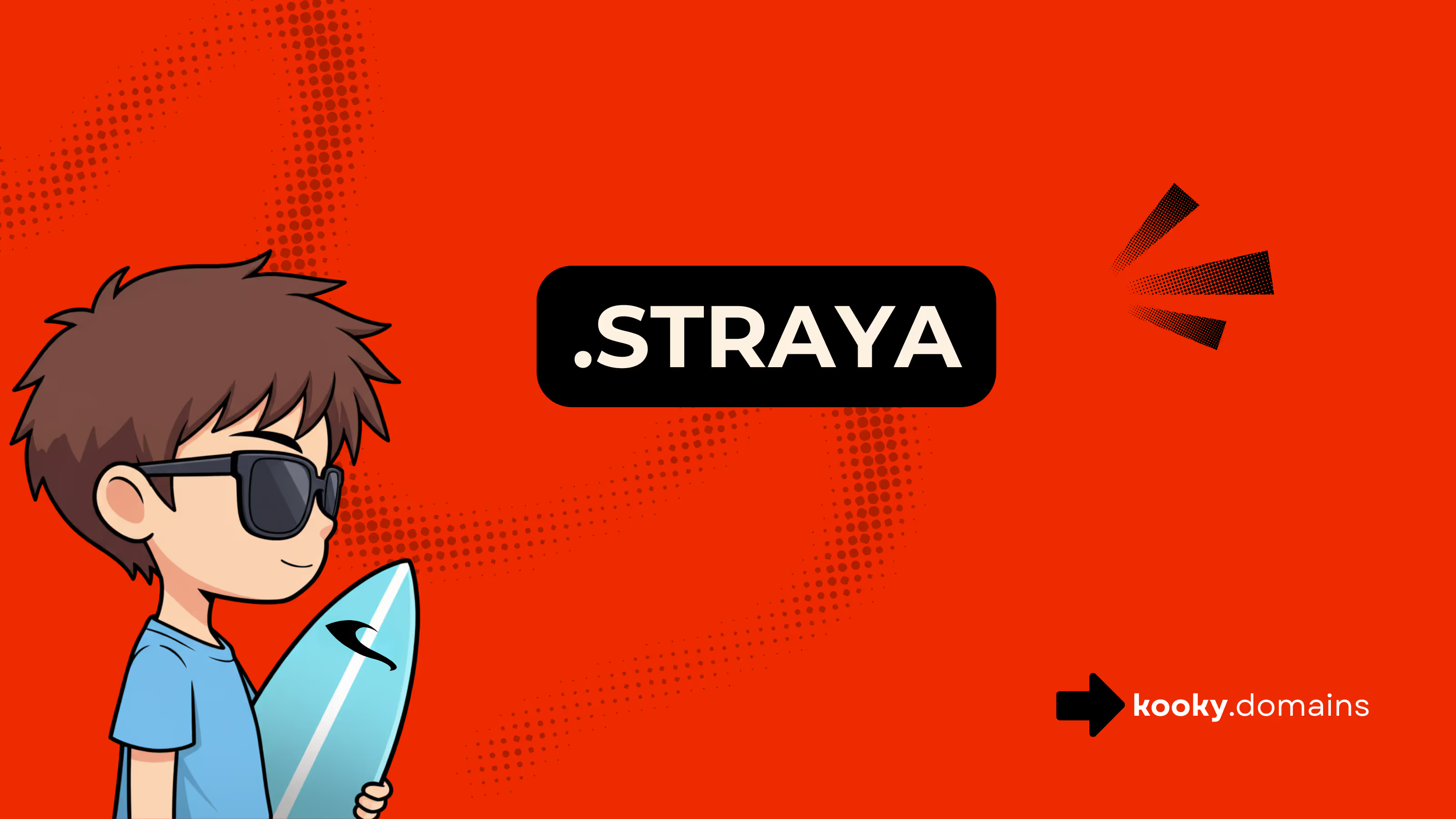
Nothing pumps the ego like owning the one word everyone secretly worships, your name, your brand, your status, right there in the URL. It’s vanity, but with purpose, like turning up to a barbie with the best seat, the best yarn, and the best handle, and nobody can pretend they didn’t notice.
That’s the vibe of the Ultimate Ego Slab, a short, loud identity you can drop anywhere you share a link. With .straya, the Aussie energy is baked in. It reads like an inside joke, a chant, and a calling card all at once, vanity on an infinite long weekend.
If you’re new to the idea, an onchain domain is simple, it’s a name you control on a blockchain. Instead of renting a profile name on one app, you hold the name in a way that can travel with you across places that support it. This post breaks down what an “ego slab” looks like in domain form, why .straya stands out, how to choose a name that lands, and how to use it without sounding cringe.
An “ego slab” is a bold identity badge, like a vanity plate, but for the internet. It’s not about being subtle. It’s about being instantly clockable, a word that signals status, humor, confidence, or belonging in one hit.
In the context of this post, we’re talking about onchain domains in the Kooky ecosystem. Kooky domains are all onchain, owned by Kooky and powered by Freename. That matters because the point of an ego slab is control and consistency, not building a fragile identity that disappears when a platform changes rules.
Also, this is not about buying an entire extension or running your own registry. It’s about choosing a name under .straya and using it as your front door.
A vanity plate gets seen at stoplights and in parking lots. A vanity domain gets seen everywhere you share it, your socials, your wallet, your group chat, your QR code on a sticker, your event promo link, your email signature.
Think about how people react when you drop a link, what do they notice first, the destination or the name, and does it feel like you. A clean, punchy domain does work before anyone clicks. It can feel like a wink, or a mic drop, depending on the word you choose.
One-word names feel premium for the same reason a great nickname sticks. They’re easy to remember, fast to type, and hard to ignore. They don’t ask for attention, they take it.
Good ego slab words tend to fall into a few buckets:
Two guardrails keep it smart instead of sloppy. First, don’t copy brands or ride on someone else’s name. Second, don’t use slurs or hateful terms, even as “irony”, it stains everything you build on top of it.
Some extensions are background noise. .straya is the opposite. It’s cultural signal in six letters, playful, loud, and unmistakably Aussie, even before anyone reads the name on the left.
That’s the secret sauce for an ego slab. The extension does half the talking. You can keep the word simple and still get a full personality in the full address.
And again, we’re talking about Kooky domains here, onchain, owned by Kooky and powered by Freename. Keep your expectations realistic, support and display depends on the apps and sites you use, but the identity piece is the constant.
Say it out loud and you’ll hear it. Dot straya has rhythm. It sounds like a punchline, or a slogan, or the last word of a toast. That matters because most links get shared in conversation first, someone says it, someone else types it.
The emotional payoff is real. People use identity links to show they’re part of something, to signal humor, mateship, or a little chaos, without writing a bio essay.
Use cases that fit the tone naturally include creator pages, merch drops, community groups, local businesses with personality, meme projects, and simple event links. The best ones feel like a badge, not an ad.
The most practical places for a .straya onchain domain are the places where names get repeated. Social bios. Link-in-bio pages. Pinned posts. Wallet naming in apps that support onchain names. QR codes on posters, stickers, menus, and signs.
Some people also use third-party services for things like forwarding or messaging style workflows. The key is to stay tool-agnostic and focus on outcomes, your ego slab should resolve to something real, and it should be easy to reach from a phone in under ten seconds.
If it only works when you explain it, the flex disappears.
The best ego slabs don’t sound like they were built in a boardroom. They sound like something a friend would actually call you, or something you’d happily put on a hoodie.
A simple framework helps:
There’s also a reality check. Your name can be fun, but it still has to survive real life. If you plan to use it for work, collaborations, or events, don’t pick something that forces awkward explanations every time you share it.
Finally, be smart about safety and ethics. Avoid trademarks. Don’t impersonate people. Think long term, because your ego slab becomes your receipts.
This test saves you from pain later. You say your domain out loud, once, like you would in a noisy room. Then your friend types it without help. If they miss it, your future followers will miss it too.
Common traps are sneaky. Double letters that nobody hears. Weird abbreviations. Extra characters to force uniqueness. Numbers that can be read multiple ways. Anything that makes people ask, wait, is that with a dash, is that with two vowels, is that a zero or an O.
A quick tip that stings but works, if you must explain it, it is not the one.
Tone is your weapon here. Choose one lane and stay in it.
Funny names work when they feel effortless, like something you’d say with mates. Bold status words hit when you can back them up with your work, your content, or your presence. Clean real-name style is underrated because it signals confidence without shouting.
A useful gut check is this, do you want laughs, respect, or both, and can your word deliver that without extra text around it. When you mix tones, the punch weakens. A “serious” word next to a goofy word often reads like you’re trying to cover both outcomes, and that reads as unsure.
An ego slab isn’t a trophy if it leads nowhere. The win is when it becomes a working front door.
Start simple. Point it to one destination you control, like a profile, a landing page, or a main site. Then put it everywhere you already show up. Bio, pinned post, QR, merch tag, livestream overlay, flyer, even your phone lock screen if you’re that person.
Over time you can get smarter. Use it as a campaign link for a drop. Use it as a community hub for sign-ups. Use it as a clean redirect that you can swap when your priorities change, without asking people to learn a new link every month.
The fastest way to ruin a great name is to treat it like a gag. People respect a clean, working link that feels intentional. They roll their eyes at a domain that looks like a stunt.
If you’re a creator, your .straya can be the one link you say on a podcast, the one link you print on stickers, the one link you trust fans to remember. If you run a small business, it can be the short URL on a menu, a window decal, and a receipt. If you organize community stuff, it can be the easy join link that turns curious strangers into regulars.
In all cases, consistency is the real flex.
Placement is everything. Put your .straya where people already expect a link, and where it helps them act.
Social bios are the obvious start. A pinned post helps because it shows context, what the link is for, why it matters. Email signatures work when you keep the copy short and let the domain do the talking. Business cards still matter for local scenes, same with storefront decals if you have foot traffic. Livestream overlays and event flyers are perfect because they’re designed for quick scanning.
The rule is simple. If your domain replaces a longer, uglier link, it feels classy. If you add it on top of five other calls to action, it feels like noise.
A few missteps can flatten the whole idea, even if the name is perfect.
Keep security basics in mind too. Protect your keys. Be wary of random sign-in pages and rushed DMs. Your identity is only as strong as how you guard access to it.
The Ultimate Ego Slab is simple, one word that broadcasts identity and confidence, and .straya makes it unmistakably Aussie before anyone even clicks. Define your vibe, pick a name that passes the 5 second test, set a real destination, then use it the same way everywhere so it builds trust.
Choose a word you’d proudly say out loud in a noisy room, then make it your front door online.