.svg)
.svg)
Discover .queensland
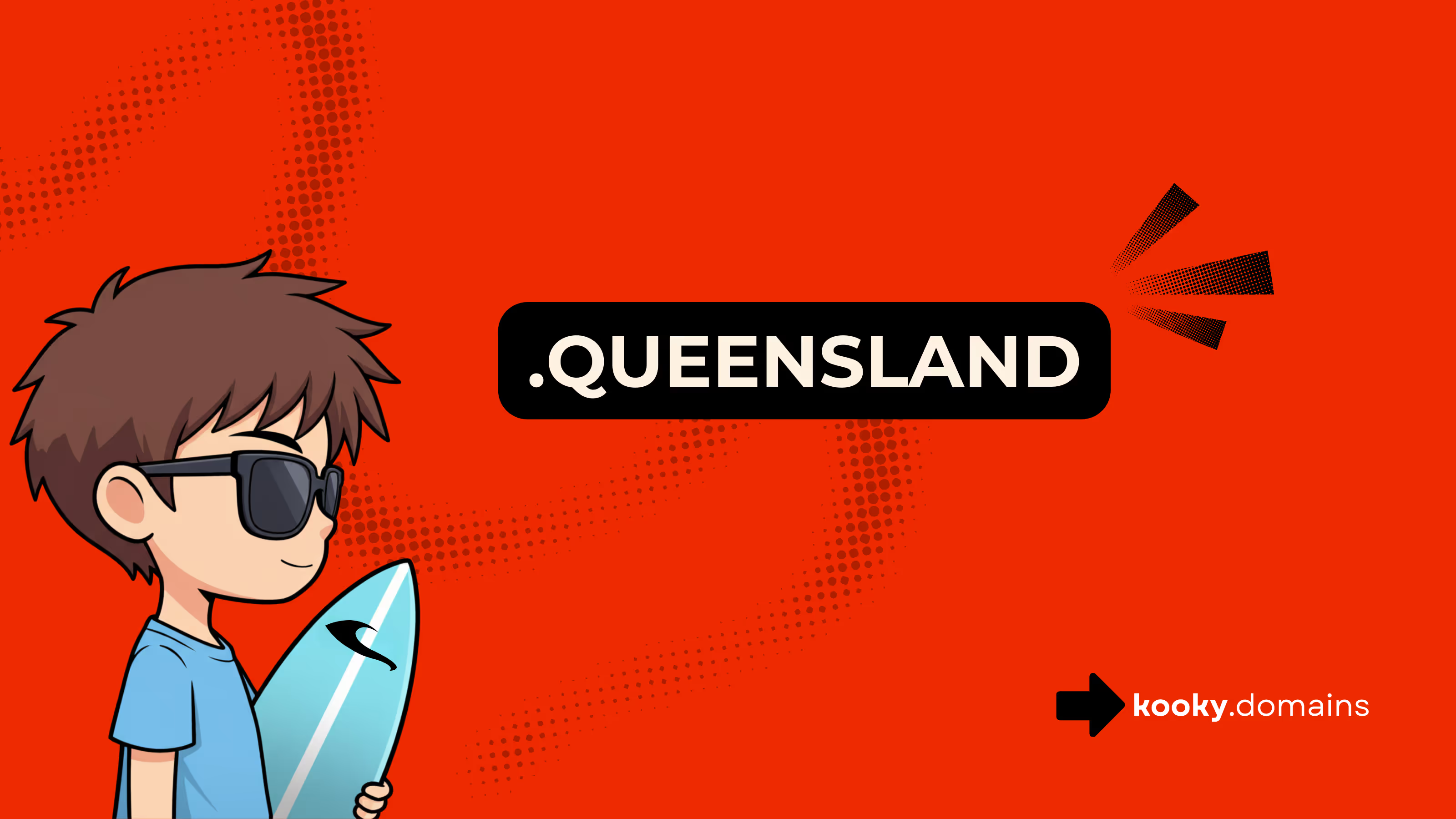
Queensland used to be a pin on a map, a license plate, a place you’d fly into and out of. Now it’s being talked about like something you can carry, defend, and pass down.
“Queensland is now a bloodline” isn’t a government slogan or a legal status. It’s a story people are choosing to live inside. The idea is simple: Queensland shifts from geography to identity, like a crown you can hand to your kids, not just a destination you visit.
And once identity moves online, proof matters. That’s where onchain domains come in, including Kooky onchain domains (all onchain, owned by Kooky, powered by Freename) as a way to claim and prove that identity in a public, lasting way. What if your family name could also be your onchain address?
Some people will claim Queensland first. Others will show up later and realize they’re treated like visitors.
At face value, “bloodline” sounds intense. It brings to mind royal families, surnames, inheritance, and the feeling that some things belong to you because you were there early, or because your people were.
In online culture, “bloodline” also shows up as slang for life-changing outcomes, the kind that change your family’s future. But in the Queensland onchain context, the more useful meaning is identity based: a hereditary badge, a digital surname, a proof that you belong to a story and a community.
This is not official policy. It’s not a title deed to land, and it doesn’t replace citizenship or legal rights. It’s closer to a signal, a membership line, and a reputation anchor, the kind of thing people recognize when they see it repeatedly in wallets, profiles, and messages.
When you hear “Queensland is now a bloodline,” think of four ideas:
That last point is the spark. Ownership is what turns a vibe into an inheritance.
Living in Queensland is one kind of connection. Visiting is another. Carrying Queensland as part of your name across years is different again.
People already do this offline. Think about:
A last name that traces back to a town, a family crest on a ring, a tattoo of coordinates, a bumper sticker that says “born and raised.” None of it is law, but all of it communicates belonging.
Onchain identity is the modern version of that. A name you hold and control can act like a badge you wear everywhere. It can show up in your wallet activity, your social bios, your contact card, your payment link, and your community accounts.
The shift happens when a place-name becomes scarce. Not everyone can be “Queensland” online in a clean, simple way. The best names are limited, and once taken, they don’t come back unless the owner chooses to transfer them.
Digital names don’t stay available for long when a story catches fire. One day the best handles look wide open. Then the next day, the obvious ones are gone, and people start adding extra words, extra letters, or awkward punctuation.
The rule is plain: first claim wins. Not because it’s fair, but because that’s how scarce naming works when ownership is recorded and recognized.
There’s also a personal side to it. Nobody wants to feel locked out of their own identity. If your family, brand, or community wants to carry Queensland as a banner, waiting can turn you into someone who “supports it” instead of someone who “is it.”
That difference sounds petty until you see it in practice.
An onchain domain is a name recorded on a blockchain. Instead of being controlled by a company account and a password reset link, it’s controlled by a wallet. If you control the wallet, you control the name.
That’s the core mechanic that makes the “bloodline” metaphor work.
With a normal username, you can lose access because of a ban, a policy change, or a platform shutdown. With an onchain domain, the record is public and the control is tied to your keys. You can transfer it like property. You can keep it for decades. You can hand it down.
Kooky onchain domains (owned by Kooky, powered by Freename) fit neatly into this story because the “Queensland” idea needs a proof layer. If a name is meant to act like a crown, people need a simple way to check who holds it.
This is also why “hereditary” is more than a vibe. It’s a plan.
Hereditary in practice looks like:
Onchain domain ownership is easy to explain:
That proof feels like “bloodline proof” because it’s public and hard to fake. People don’t have to trust your screenshot. They can verify the record.
It also lasts. Platforms come and go, and bios get wiped, but an onchain record is designed to persist as long as the chain does. If Queensland is going to be a long-running identity, permanence matters more than aesthetics.
If a Queensland-style name is meant to last, don’t treat it like a casual handle. Treat it like an heirloom with keys.
Practical handoff options, in plain language:
One caution that saves pain later: scams love valuable names. Never share seed phrases, don’t click random “verification” links, and don’t rush transfers because someone created panic in your DMs.
Online identity is rarely granted. It’s claimed, earned, and recognized over time.
That’s why the bloodline metaphor hits. A clean Queensland-themed onchain domain can signal that you didn’t just pass through. You showed up early enough to plant a flag, you held it long enough to be known for it, and you cared enough to secure it properly.
This isn’t about excluding people who love Queensland. It’s about understanding how scarce identity works once names become assets. When a name is limited, speed and clarity matter.
Think of it like front-row seats. Everyone can enjoy the concert, but not everyone can sit in the first row. Those seats go to the people who got there first.
A strong name does quiet work for you. It reduces friction. It helps people remember you. It makes it easier for communities to organize around “real” holders instead of lookalikes.
In onchain communities, names often tie into:
Community chats that check ownership, allowlists for mints, event invites, collab channels, and private drops. None of that is guaranteed, and it shouldn’t be. But the pattern is common: groups use ownership as a filter because it’s simple to verify.
And it shapes trust fast. If two people claim Queensland, who will people trust first? The one with a consistent, verifiable onchain name usually wins the first impression, even before the first message is read.
Recognition compounds. The longer you hold a name, the more it feels like yours.
Waiting has a cost that doesn’t show up on day one.
You end up with longer names that people mistype. You rely on weird spellings that don’t pass the “say it out loud” test. You spend time correcting people, or worse, you lose attention to someone with the clean version.
It can also create brand confusion. When several similar names exist, impersonation becomes easier and newcomers get tricked. You may find yourself renting trust through constant proof posts instead of owning trust through a stable identity.
Here’s the direct takeaway: if Queensland is part of your identity, claim it while the best names still exist.
The goal is simple: pick a name that feels like home, register it through the Kooky and Freename experience, store it safely, then connect it to the places people already look.
Keep the process boring on purpose. Boring is safe, repeatable, and easy to maintain for years.
At a high level, the flow looks like this:
Choose your Queensland-style name, register it through Kooky (powered by Freename), confirm it’s owned by your wallet, then set your public connections (payments and profile links) so people can find you. After that, lock down custody so it’s not lost in a phone upgrade or a hacked laptop.
Consistency is what turns a name into a bloodline. If you use it once and disappear, it’s just a collectible. If you use it everywhere, it becomes you.
A “bloodline” name shouldn’t depend on a short trend. It should still look good when your younger cousin is old enough to inherit it.
Simple guidelines that hold up:
Go short when possible. Pick a spelling people won’t mess up. Avoid extra characters that look cool but break search and memory. Choose something you’d be proud to say at a family dinner.
Patterns that usually work:
Family name plus Queensland, a nickname plus Queensland, or one strong word tied to Queensland culture and values. The best choice is the one you can keep using without feeling embarrassed later.
A name has no power if it stays hidden.
Once you own the domain, use it as your public front door. Connect it to the places that matter to you, such as a payment address, a profile hub, a storefront, or a message route.
A simple setup checklist you can follow in normal life:
Put the domain in your bio where you’re active. Pin it in the places you post most. Use the same name across socials when you can. Verify ownership anywhere the platform supports it. Keep a single “official” version of your name, and stick to it.
This is how you stop being a visitor. You show up with the same flag every time.
“Queensland is now a bloodline” is a modern way to say that identity can become inheritance. Not on paper, but in public records people actually use online.
Onchain domains make the idea real because ownership is verifiable, transferable, and built to last. The swiftest claims get the cleanest names, and the cleanest names become the easiest to recognize.
Claim a Queensland-style Kooky onchain domain (owned by Kooky, powered by Freename), lock it down, and write clear handoff rules. If Queensland is part of your story, make sure you’re holding the name, not watching it from the sidelines.