.svg)
.svg)
Discover .eleague
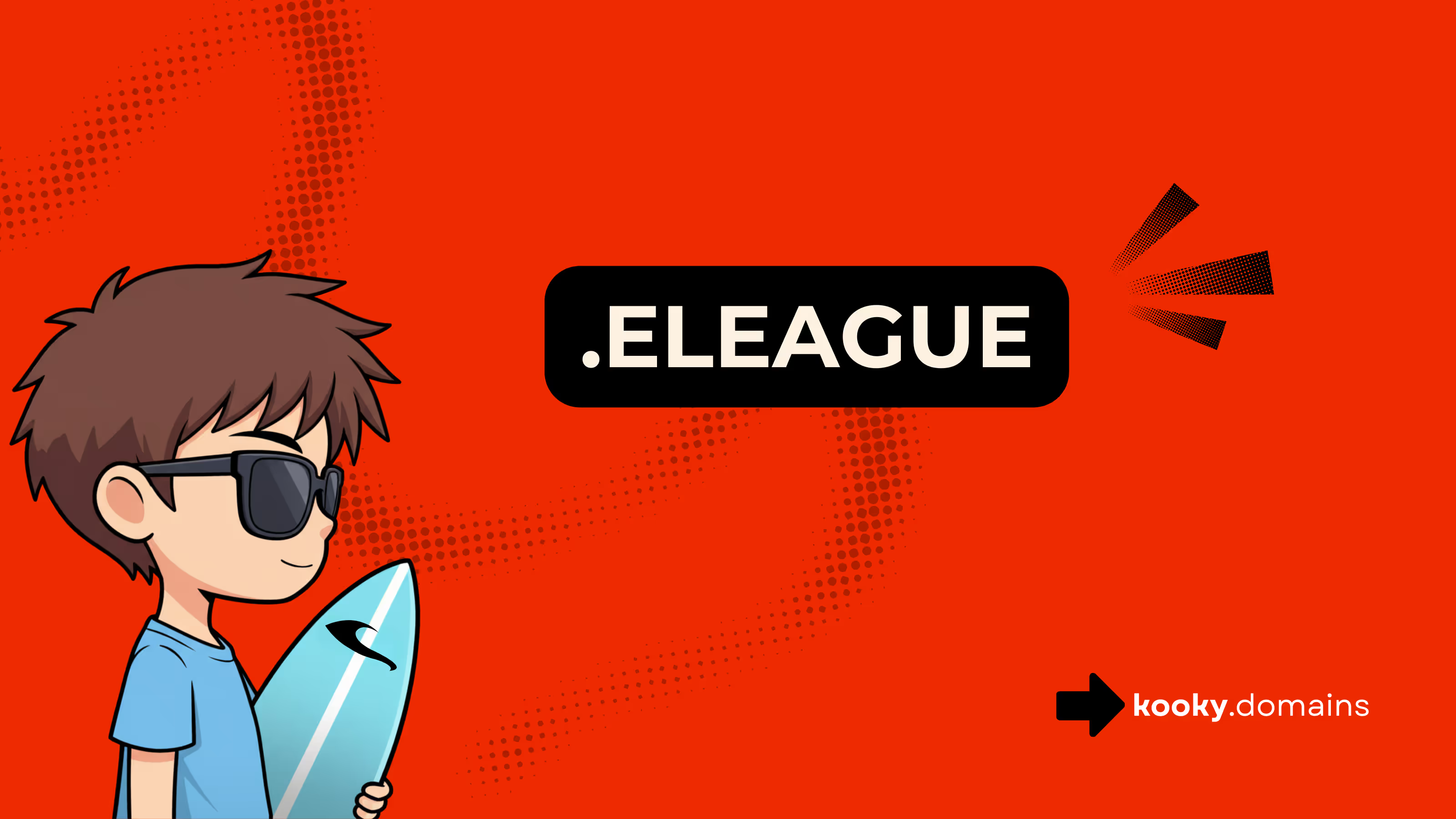
Most creators think branding is a logo problem. Broadcasts prove it’s a meaning problem.
When your show is live, people are half watching and half scrolling. They’re also reading chat, catching highlights, and jumping into clips out of context. In that mess, the words on screen teach the audience what they’re looking at, and who it belongs to.
That’s what “God Mode: Broadcast Edition” means in plain terms: God Mode is total control of what viewers understand, and Broadcast Edition means it’s designed to survive live, replay, clips, and highlights. If your name isn’t the clearest thing in the frame, the internet will name you for you, and when a clip spreads, what name stays with it is the whole fight. This is where onchain domains fit, and why a semantic handle like .eleague can act like a permanent, high-production identity that’s hard to ignore.
Semantics are the labels and cues that tell people what something is. Not your mission statement, not a thread, not a long explainer, just the words and signals a viewer can grab in one glance.
Broadcasting is a stack of semantic layers. The lower third tells you who’s speaking. The score bug tells you what matters right now. Overlays tell you where to look. Audio stingers tell your brain, “this moment is important.” Scene titles and segment cards tell you what kind of show this is.
A clean semantic system doesn’t beg for attention. It makes the audience feel like they already know you. That’s the real power: clarity, recall, authority. No hype required.
People trust what repeats. If a name sits in the top-left corner the whole match, the brain files it as the source. If a short domain flashes during big moments, it becomes the “official” place to go. If casters say the same tag every round, chat copies it, and repetition does the heavy lifting.
Small choices create big memory. Placement matters, timing matters, and consistency matters. A name shown for half a second during a quiet moment gets ignored, but the same name shown during a clutch play sticks because attention spikes.
This is also why a single, readable anchor beats a pile of links. Viewers don’t want homework, they want one obvious truth they can repeat without thinking.
Your content has three audiences, and they don’t behave the same.
Live viewers see your full package, overlays, host lines, intermission cards, all of it. VOD viewers skip around, and they might never see your intro. Clip viewers get one moment ripped from the stream, often cropped, reposted, and stripped of context.
A short, readable domain helps in each mode. Live, it’s the steady “this is the show” label. In VODs, it’s the breadcrumb that stays visible when people scrub. In clips, it’s the watermark that survives the repost.
The goal is simple: make the semantic anchor impossible to miss and easy to say out loud, so the audience does your distribution for you.
A broadcast is a stage, and whoever controls the on-screen words controls the story. A domain like name.eleague works like a clean, high-production handle because it reads like a title, not a random link.
Onchain domains add another layer: ownership. You’re not borrowing space on a platform where your handle can change, your reach can drop, or your link can break. You’re putting a single identifier on screen that you can carry across channels and formats.
Kooky domains are described as onchain domains, owned by Kooky and powered by Freename, and the basic idea fits the broadcast need: one name that stays consistent as your show grows and your distribution spreads.
Most brand breakage is boring. A creator changes their handle on one platform, their link tree changes, an old promo URL dies, and suddenly half the audience is lost. On a broadcast, that’s a problem because your show doesn’t live in one place. It lives in replays, reaction videos, and screenshot threads.
A stable onchain domain can act as the identity layer across your overlays, channel bios, merch callouts, and sponsor decks. One name, everywhere, so the audience doesn’t have to guess which link is real.
It also helps with imposters in a calm way. You don’t need fear, you need a single canonical label that you always show in the same place, so copycats look wrong on sight.
High-production isn’t fancy motion graphics. It’s a system that repeats.
In practice, it looks like this:
The audience learns names through repetition, not persuasion tricks. If you want semantic control, you don’t need louder graphics, you need fewer variables.
This part is tool-agnostic. Whether you’re in OBS, vMix, or a studio control room, the rule is the same: plan what the viewer learns, then make the screen teach it on schedule.
Use your onchain domain as the anchor, and treat everything else as support. If you’re using Kooky domains powered by Freename, the same on-screen logic applies: the domain is the spoken name, the written name, and the clip watermark.
A semantic loop is the cycle of moments where your name appears with purpose. If someone joins late, how fast can they learn your name without asking chat?
Build the loop like this:
Each piece does one job. Together, they make your identity unavoidable.
Your on-screen name should match the spoken name. If it’s hard to say, it won’t spread.
Aim for:
A one-sentence script helps hosts stay consistent without sounding like an ad. Example: “You’re watching [Show Name], full episodes and clips live at name.eleague.” Say it once per segment, not every minute, so it stays natural.
Clips get cropped. They get reposted with captions covering the bottom third. They get viewed on phones with tiny safe areas.
Place your domain in a corner that’s least likely to be covered, and keep it inside a safe zone with strong contrast (light text on dark, or dark text on light). Make the text big enough to read in one second, because clips move fast and nobody pauses to squint.
Most of all, keep it typeable from memory. If a viewer can’t retype it after one glance, you didn’t really own the moment.
If you want God Mode results, you have to protect the audience’s attention. Confusion is the tax you pay for being messy.
Rotating handles kills recall. So does stacking multiple URLs on the same overlay. Viewers aren’t choosing between your options, they’re abandoning the decision.
Pick one primary onchain domain as the anchor. Everything else can exist, but it should behave like a supporting actor. The audience should never wonder which link is official, and they shouldn’t need to remember three different spellings.
Flash can bury meaning. If your overlay is busy, your domain becomes decoration, and decoration doesn’t get remembered.
Use a simple rule: one clear domain, readable in one second, shown during peak attention moments (round start, big win, segment intro). Let the gameplay and the host carry the energy, and let the naming system carry the identity.
God Mode: Broadcast Edition is about semantic control that sticks across live streams, VODs, and clips. When you treat your on-screen words as the product, you stop hoping people remember you and you start teaching them.
A handle like .eleague can work as an onchain domain identity layer that feels permanent and high-production, as long as you pair it with consistent broadcast cues. Choose the one name, place it inside a semantic loop, and make every moment teach it, so the next time your highlight escapes into the wild, you’re not left wondering who gets credit for it.