.svg)
.svg)
Discover .aiot
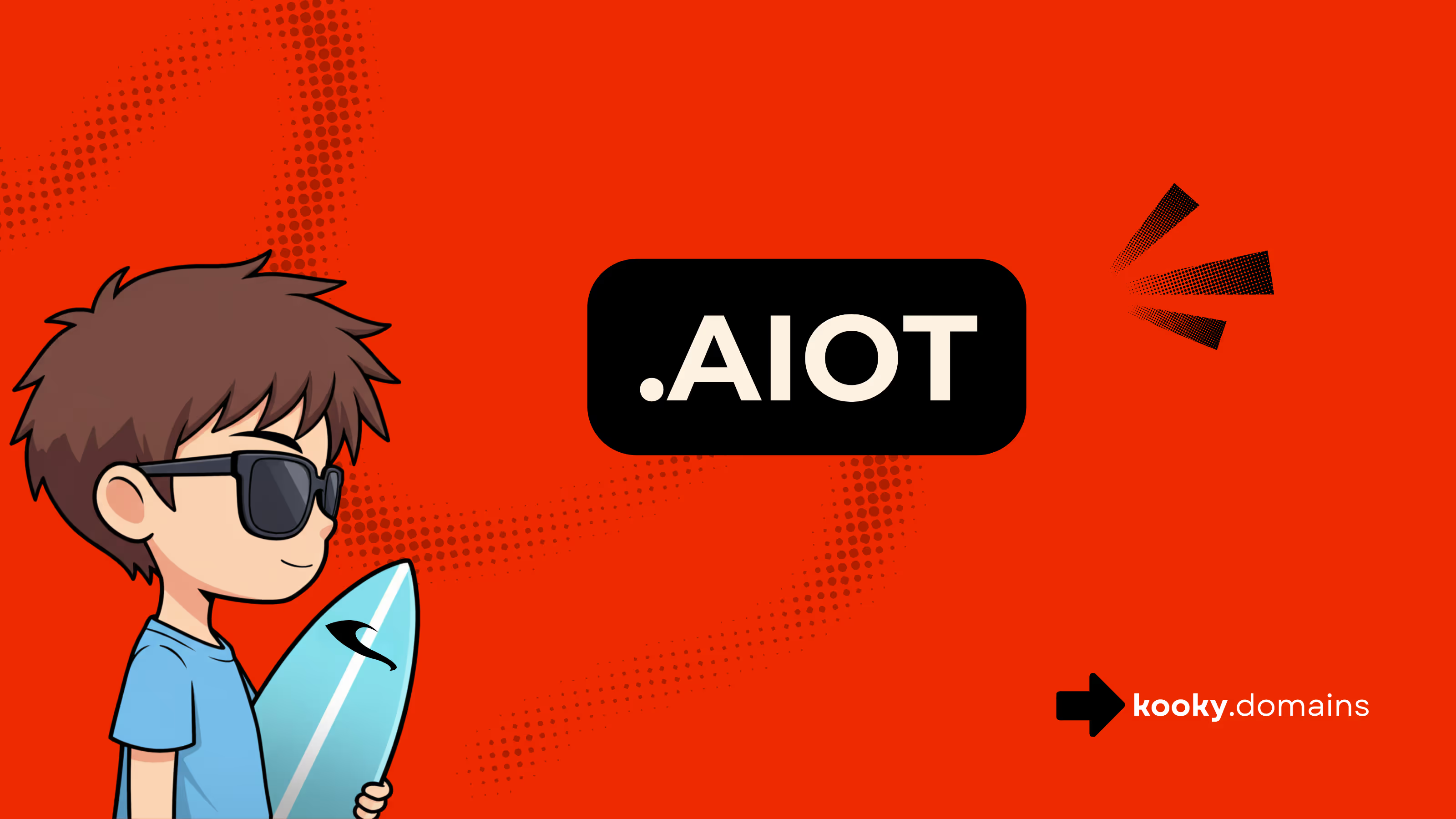
Picture your home, your business, and your tools acting like a small team that never sleeps. Lights adjust, energy routes itself, deliveries get logged, support messages get answered, and security checks happen on schedule. That’s AIOT in plain terms: AI plus connected devices working together to sense, decide, and act.
Now add one twist, this isn’t just “smart tech” anymore. It’s becoming dynastic, meaning it can be passed down like a house, a family business, or a set of keys. The automations, permissions, trusted relationships, and even paid services can keep producing value long after the first setup.
The big question hiding in plain sight is ownership: who will own the names that AI agents and smart devices trust when they need to identify you, verify you, and pay you? That’s where onchain domains fit, especially human-readable names like a .aiot identity that can point to devices, agents, wallets, and rules.
Most people buy “smart” products like they buy appliances. You pay once, install it, then forget about it until it breaks. AIOT changes that pattern because the value doesn’t come from the gadget alone. It comes from the system you build around it.
Over time, connected devices produce useful signals (energy use, temperature trends, motion events, equipment health). AI agents can turn those signals into actions (shifting power use to cheaper hours, flagging odd activity, re-ordering supplies, routing messages to the right person). The more you use it, the more it learns your routines and the more it can automate without you thinking about it.
That’s why ownership matters more than usage. If you “use” an AIOT stack but someone else controls the identity, the permissions, and the endpoints, you’re basically renting your own system. A dynastic setup looks more like a family asset because the control layer can be inherited, along with the policies that make everything run.
This is what “protocol empires” look like in real life. Not an empire of castles, an empire of rules and routes. Who can access the cameras, which agent can approve a refund, where sensor data goes, what gets logged, what gets paid, and what gets blocked. If that sounds abstract, think of it like the wiring and breaker panel behind your walls. You don’t see it every day, but it decides what works.
A smart device is easy to picture: a thermostat, a lock, a camera, a meter. You buy it and it does a job.
A smart agent is different. It acts for you. It can schedule, negotiate, verify, pay, and message. It can talk to other systems and make choices based on rules you set. That’s where control becomes the real issue.
In a home, an agent might manage energy, it can coordinate solar, battery, EV charging, and time-of-use rates. In a small business, an agent might monitor inventory sensors and place re-orders, or triage customer emails and hand off the hard cases to staff. In a community setting, a neighborhood microgrid could use agents to share energy data and settle costs.
But when an agent takes action, it has to prove identity. It can’t just say “trust me.” If a device gets a command to unlock, or a wallet gets a request to pay, what happens when an agent needs to prove it is really yours in a way other systems can check?
That proof is where naming and onchain ownership start to matter, because identity can’t be a guessing game.
AIOT gets stronger the way a good routine gets stronger. A few small habits add up, then they start supporting each other.
First you connect one device. Then another. Then you add a rule. Then an agent starts coordinating rules across devices. Soon you have “muscle memory” built into your home or business. That’s compounding: more devices create more signals, more signals create better automations, better automations build trust, and trust opens up new ways to earn or share value.
A few grounded examples:
This is where the line lands: you can inherit .aiot or inherit perpetual silicon FOMO. One path hands your family a system they can control. The other hands them a pile of devices they might not be able to access.
AIOT sounds like a bunch of parts, because it is. Sensors, cameras, hubs, apps, AI agents, wallets, notification channels, access lists, and logs. Without a clean way to name and organize it all, people end up with chaos: random device names, scattered accounts, and permissions no one remembers.
A simple naming layer fixes more than it seems. A good name becomes the front door to everything: devices, agents, wallets, permissions, and messaging.
That’s the core idea behind onchain domains. In plain language, an onchain domain is a name you truly own onchain, not a username rented from a company that can change the rules later. You can point that name to what you control, rotate what needs rotating, and still keep the human-friendly label.
For AIOT, a .aiot name can act like a map legend. Instead of memorizing a dozen wallet addresses and endpoints, people see one root name, then follow subnames to the right place. It also helps in stressful moments, like when a device fails, a phone is lost, or a family member needs access quickly.
Machines don’t think like humans, but humans still run the show. Human-readable names help everyone move faster with fewer mistakes.
With a good naming system, a family can:
A short scenario makes it concrete. Imagine a family with solar, a home battery, and a smart panel. They also run a small workshop behind the house. They set up a root .aiot name, then create subnames for home power, workshop equipment, and their household agent. When the battery warranty service asks for logs, the family shares a permissioned endpoint tied to a subname. When the workshop buys parts, payments go to a named wallet that the bookkeeper can recognize. When the agent schedules repairs, it signs actions under an identity that others can verify.
The point isn’t magic, it’s less confusion. Less confusion is a security feature.
Most connected life is built on accounts and keys. If those keys vanish, the “smart” stuff can turn dumb fast. People usually don’t notice until a phone breaks, an email account gets locked, or someone passes away.
Inheritance in AIOT means passing down access safely: keys, permissions, device fleets, and agent policies. It also means passing down the naming layer that points to all of it. Without that layer, heirs inherit a puzzle with missing pieces.
You don’t need advanced jargon to plan this. A few simple ideas cover most needs:
A hard question belongs in the middle of planning, not after a crisis: if you disappeared tomorrow, could your family recover your connected life without begging five different support desks?
You don’t need to rebuild your whole house to make AIOT inheritable. Start with a single root name and treat it like the “label maker” for everything else. The goal is one root name, many subnames, and clear rules.
Here’s a doable roadmap that fits real life:
If you want a concrete example source for naming, Kooky domains are all onchain, owned by Kooky, and powered by Freename. The bigger lesson is the pattern: pick one root, then organize everything under it so it stays understandable as your system grows.
A good naming pattern feels like a tidy set of folders. You want names that explain themselves when you see them a year later.
Here’s a clear structure many families and small businesses can understand:
family.aiot as the root identityhome.family.aiot for the housesolar.home.family.aiot for energy systemssecurity.home.family.aiot for cameras, locks, and alarmsagent.home.family.aiot for the household AI agentshop.family.aiot for a business or workshop setupsupport.shop.family.aiot for a customer support agentThis reduces confusion in two ways. First, it limits where people paste sensitive info, since each subname has a purpose. Second, it helps you avoid over-sharing, because you can grant access to only what’s needed. A technician might get solar.home.family.aiot access, not your full root identity.
Kooky domains are all onchain, owned by Kooky, and powered by Freename, which makes them a practical example of an onchain naming system you can build around without treating the name like a temporary account.
A dynastic AIOT stack isn’t “set it and forget it.” It’s “set it and write it down.” You’re building something other people may need to run.
Keep the security plan simple and repeatable:
This is how you avoid perpetual silicon FOMO. The fear isn’t missing the next device, it’s realizing too late that your family can’t control what you already built.
AIOT isn’t staying in the “cool gadgets” box. As agents and devices start handling money, access, and decisions, AIOT becomes an inherited protocol empire, whether people plan for it or not. Onchain domains, especially a root .aiot name with organized subnames, give you a control layer that’s easier to verify, manage, and pass down.
Choose the path with fewer regrets: inherit .aiot or inherit FOMO. Pick a root name you’ll keep, build a simple structure under it, then write down how your family recovers and succeeds it. The best time to make your connected life inheritable is before anyone needs to ask where the keys went.