Download PDF Report
.svg)
.svg)
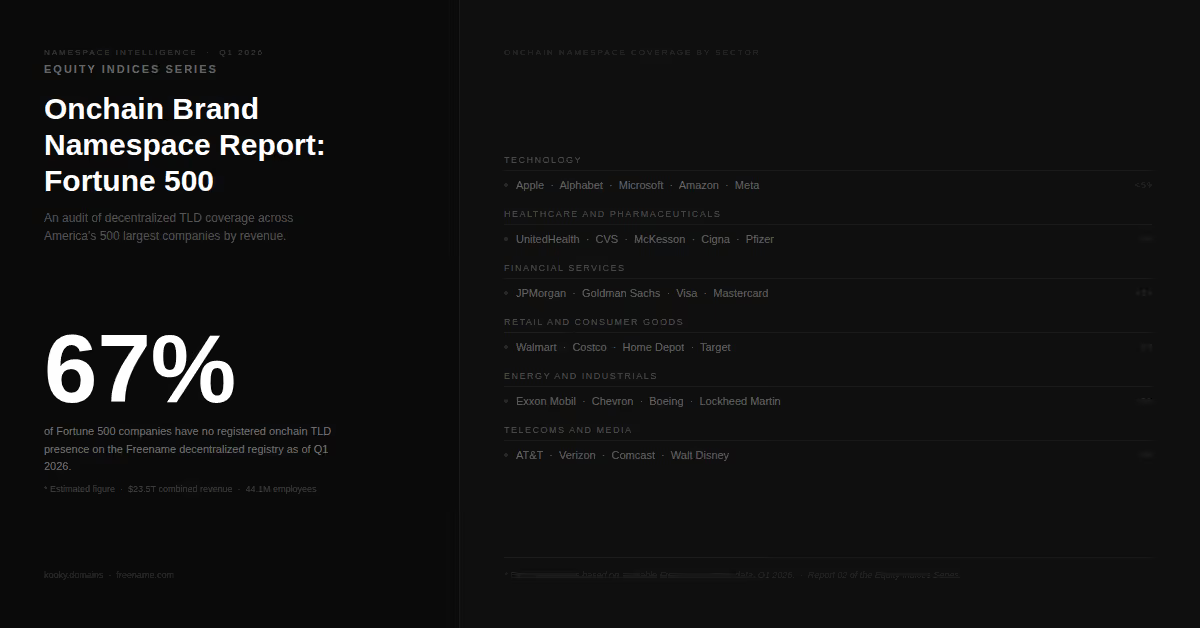
An estimated 67% of Fortune 500 companies have no registered onchain top-level domain presence on the Freename decentralized registry as of Q1 2026. Across the 500 companies comprising America's defining corporate benchmark -- representing a combined revenue of $23.5 trillion and 44.1 million employees -- the majority of corporate brand namespaces remain unregistered at the decentralized layer of the internet.
The Fortune 500 collectively represents approximately two-thirds of US GDP. Its constituents include the world's most recognized consumer brands, the largest technology companies on earth, the dominant financial institutions of the global economy, and the healthcare systems that serve hundreds of millions of Americans. Across this breadth of economic power and brand investment, the onchain namespace layer has been almost entirely overlooked.
Note: The 67% figure is an estimate based on partial registry data available at time of publication. Freename registry data is not exhaustively searchable via public API. Figures reflect best available information and will be updated as additional data becomes accessible. The Fortune 500 figure referenced reflects the most recently published annual list.
The Fortune 500 is the definitive benchmark of American corporate power. Published annually by Fortune magazine, it ranks the 500 largest US corporations by total revenue. As of 2026, these companies collectively generated $23.5 trillion in revenue and employed 44.1 million people worldwide. The list spans every major sector of the American economy -- from retail and energy to technology, healthcare, finance, and defense.
Walmart holds the top position for the eleventh consecutive year. Amazon occupies the second spot after climbing two places. The top ten includes Exxon Mobil, Apple, UnitedHealth Group, CVS Health, Berkshire Hathaway, Alphabet, McKesson, and Chevron -- a cross-section of retail, technology, healthcare, energy, and finance that reflects the breadth of the American economy.
These companies are among the most sophisticated operators of digital brand strategy on earth. Their combined investment in brand protection, cybersecurity, digital infrastructure, and intellectual property management runs into the tens of billions annually. And yet, at the onchain namespace layer -- the decentralized identity infrastructure that is becoming foundational to Web3, agentic AI, and the next generation of digital brand strategy -- the majority are absent.
A top-level domain registered on a decentralized blockchain registry is structurally different from a traditional domain name. Under conventional DNS, a domain name is leased, not owned -- subject to annual renewal fees, registrar policies, and the governance decisions of ICANN. It can be transferred, seized, or disrupted by centralized authorities.
An onchain TLD is a permanent, non-fungible asset. Registered on a public blockchain, it does not expire. It cannot be revoked by a central authority. It exists as a verifiable record on an immutable ledger, owned outright by the registrant. The namespace beneath it is the registrant's to develop, assign, or commercialize as they see fit.
For Fortune 500 companies -- organizations that spend millions annually defending their brand names in traditional DNS through defensive registrations, UDRP proceedings, and domain monitoring services -- the onchain namespace represents a new and unaddressed frontier. The same brand protection logic that drives traditional domain strategy applies directly to decentralized registries. But the mechanisms are different, the window is finite, and the cost of inaction is permanent: onchain TLD registries operate on a first-come, first-served basis with no UDRP equivalent.
Freename (freename.com) is the largest independent onchain TLD registry by registered namespace count, hosting over 32,000 registered TLDs and over 500,000 second-level domains as of Q1 2026. Unlike ICANN-governed registries, Freename operates on a multi-chain architecture -- TLD registrations are recorded across multiple blockchain networks, ensuring that registered namespaces are not locked to a single chain and remain accessible across major blockchain ecosystems.
Each TLD registered on Freename is a non-fungible asset: permanently owned by the registrant, transferable, and not subject to expiry or renewal requirements. TLD owners retain full sovereignty over their namespace, including the ability to issue second-level domains to third parties, build decentralized applications, and integrate their namespace into Web3 and agent-ready infrastructure.
As of Q1 2026, Freename has confirmed the forthcoming launch of a Vibe AI Website Builder enabling TLD owners to deploy AI-powered websites with built-in Web3 functionality, SEO and GEO agents, x402 payment protocol integration, and agent-ready domain identities directly from their onchain namespace -- making the TLD not just a namespace but an operational platform.
Each of the 500 Fortune 500 constituent companies was cross-referenced against the Freename decentralized TLD registry using the primary corporate brand name as the search string. A TLD was counted as registered where an exact or near-exact match to the corporate brand name was identified as an active registration on the Freename registry.
Subsidiary brand names, product-level TLDs, and divisional names were not included in this audit. Only the primary corporate brand name was assessed. The Fortune 500 constituent list reflects the most recently published annual ranking. Registry data completeness is limited by the absence of a fully public API from Freename at time of publication. The 67% estimate carries a margin of error and will be updated as additional registry data becomes accessible.
The technology sector includes the Fortune 500's most valuable companies by market capitalization -- Apple, Alphabet, Microsoft, Meta, Amazon -- as well as enterprise infrastructure providers, semiconductor companies, and software platforms. These companies are among the most sophisticated digital operators on earth. Apple manages one of the largest digital identity ecosystems in existence through its Apple ID system. Alphabet's Google operates the foundational infrastructure of the modern web. Microsoft has made enterprise identity infrastructure a core product category.
The technology sector's blockchain engagement is deep and growing. Microsoft Azure offers blockchain-as-a-service. Amazon Web Services has invested heavily in blockchain infrastructure products. Google Cloud has partnered with multiple blockchain networks for infrastructure services. STMicroelectronics, a Fortune 500 semiconductor company, recently secured a major multi-year contract with Amazon Web Services for AI datacenter chips.
Onchain TLD coverage across the technology sector of the Fortune 500 is estimated at below 5% for primary corporate brand names. Companies that build and sell blockchain infrastructure have not registered their own brand namespaces on blockchain-based registries.
Healthcare is one of the most heavily represented sectors in the Fortune 500, with companies including UnitedHealth Group, CVS Health, McKesson, AmerisourceBergen, Cigna, Humana, Johnson and Johnson, Pfizer, Abbott Laboratories, and Eli Lilly. These companies collectively employ tens of millions of people and manage brand portfolios worth hundreds of billions in market capitalization.
The healthcare sector is among the most active in traditional domain brand protection. The risk of counterfeit pharmaceutical sites, patient-facing brand impersonation, and phishing attacks on healthcare credentials is acute and well-documented. Healthcare companies maintain large defensive domain portfolios and active UDRP enforcement programs.
Yet onchain TLD coverage across the healthcare sector of the Fortune 500 is estimated at zero for primary corporate brand names. An industry that invests heavily in traditional brand protection has not extended that investment to decentralized namespace registries.
The financial services sector of the Fortune 500 includes JPMorgan Chase, Bank of America, Wells Fargo, Citigroup, Goldman Sachs, Morgan Stanley, American Express, Visa, Mastercard, and dozens of regional banks, insurance companies, and asset managers. These institutions are among the most regulated and brand-sensitive organizations in the American economy.
Financial services companies are also among the most active blockchain adopters in the Fortune 500. JPMorgan Chase operates its own blockchain network, JPM Coin. Goldman Sachs has issued tokenized bonds. Visa and Mastercard have both announced blockchain-based payment infrastructure initiatives. The intersection of financial services and blockchain technology is one of the most active areas of enterprise technology investment.
Onchain TLD coverage across the financial services sector of the Fortune 500 is estimated at below 3% for primary corporate brand names. Institutions building blockchain financial products have not secured their onchain namespace.
Retail is the Fortune 500's dominant sector by revenue, led by Walmart at $611 billion in annual revenue. Amazon, Costco, Kroger, Home Depot, Target, Lowe's, and dozens of other retail and consumer goods companies follow. These companies operate some of the most visited digital properties on earth, with e-commerce ecosystems that process billions of transactions annually.
The retail sector's digital brand investment is enormous -- Walmart and Amazon each spend hundreds of millions annually on digital brand protection, customer authentication, and anti-fraud infrastructure. The onchain namespace represents a new layer of this infrastructure that has not yet been addressed. Onchain TLD coverage across the retail sector of the Fortune 500 is estimated at zero for primary corporate brand names.
The energy sector is represented by Exxon Mobil, Chevron, ConocoPhillips, Phillips 66, Valero Energy, and dozens of utility and pipeline companies. The industrials sector includes aerospace and defense companies such as Boeing, Lockheed Martin, Raytheon, and General Dynamics, alongside manufacturing and logistics companies.
Energy companies have been active in blockchain pilot programs for commodity trading, carbon credit tokenization, and supply chain tracking. Several Fortune 500 energy companies have participated in consortia blockchain networks for trade finance and settlement. Onchain TLD coverage for this sector is estimated at zero.
AT&T, Verizon, Comcast, Charter Communications, and Walt Disney Company represent the telecommunications and media segment of the Fortune 500. These companies provide the physical and content infrastructure of the American internet and media ecosystem. Onchain TLD coverage for this sector is estimated at zero for primary corporate brand names.
One of the most significant near-term drivers of onchain namespace adoption among Fortune 500 companies is likely to be agentic AI infrastructure. AI agents -- autonomous software entities that browse, transact, and communicate on behalf of organizations and their customers -- require stable, machine-readable, and verifiable identity anchors. Onchain TLDs are emerging as a foundational layer for agent-ready identity: a namespace that an AI agent can resolve, verify, and interact with without relying on centralized intermediaries.
Fortune 500 companies are among the most active deployers of enterprise AI. Microsoft's Copilot, Google's Gemini enterprise products, Amazon's AWS AI infrastructure, and Salesforce's Einstein AI platform are each being integrated into Fortune 500 operations at scale. As these agentic systems mature and begin to operate autonomously across digital infrastructure, the question of onchain identity -- who the agent is, which organization it represents, and how that identity can be verified on a decentralized basis -- will become a pressing operational concern.
Organizations that have established their onchain namespace will be positioned to deploy agent-ready identity infrastructure. Those that have not will face the challenge of acquiring namespace assets under conditions less favorable than today's first-come, first-served environment.
The Fortune 500's onchain namespace gap is consistent with the broader global pattern documented in this report series. The CAC 40, France's benchmark equity index, shows an estimated 85% gap in onchain TLD coverage -- higher than the Fortune 500 estimate, reflecting the CAC 40's concentration of brand-intensive luxury and consumer goods companies. The DAX 40 and FTSE 100 are expected to show comparable figures when audited in forthcoming editions of this series.
The Fortune 500's lower estimated gap -- 67% versus 85% for the CAC 40 -- may reflect the higher concentration of technology companies in the US index, some of which have more active Web3 and blockchain programs that include namespace registration. However, this estimate carries significant uncertainty and will be refined as additional registry data becomes available.
What is consistent across all indices examined to date is that the gap between blockchain investment activity and onchain namespace registration is wide, and that the gap shows no sign of self-correcting without deliberate strategic attention from enterprise brand and IP teams.
For Fortune 500 companies, the absence of onchain namespace coverage carries four categories of strategic risk that enterprise brand and IP teams are beginning to assess.
The first is namespace pre-emption. Onchain TLD registries operate on a first-come, first-served basis. Unlike traditional DNS, where ICANN's UDRP process provides a mechanism for reclaiming domains registered in bad faith, decentralized registries have no central authority to adjudicate disputes. A namespace registered by a third party on a decentralized registry is that party's permanent asset. For a Fortune 500 company with a well-known brand name, the window during which that name is available as an onchain TLD is finite and closing.
The second is identity fragmentation. As Web3 infrastructure matures and onchain identity becomes a standard component of digital interaction, organizations without a registered onchain namespace will find their brand identity fragmented -- present in traditional DNS, absent in decentralized DNS. For consumer-facing brands with global digital audiences, this fragmentation has direct implications for brand consistency, customer trust, and digital marketing coherence.
The third is infrastructure readiness for agentic AI. As discussed above, the deployment of autonomous AI agents requires stable onchain identity infrastructure. Organizations that have not established their namespace will face acquisition costs and delays at the point when this infrastructure becomes operationally necessary.
The fourth is competitive positioning. As onchain namespace coverage becomes a standard element of enterprise digital brand audits -- a process that is already beginning among IP monitoring firms, brand protection agencies, and digital strategy consultancies -- the absence of coverage becomes a visible gap in a company's digital brand posture relative to peers that have acted.
The Fortune 500's onchain namespace gap is the defining finding of this report. The world's largest and most sophisticated corporate brands -- companies that collectively represent two-thirds of American GDP and employ tens of millions of people -- have largely not addressed the decentralized namespace layer. This is not a reflection of strategic judgment against decentralized infrastructure; it reflects the early stage of enterprise awareness of a new class of digital brand asset.
The ICANN Round 2 new gTLD application window opening in 2026 is already prompting Fortune 500 legal and IP teams to conduct broader namespace audits. These audits are increasingly examining decentralized registries alongside traditional DNS. The growth of agentic AI infrastructure is creating new demand for onchain identity anchors that Fortune 500 companies have not yet addressed. And the maturation of Web3 consumer products is bringing decentralized namespace resolution into the mainstream digital experiences that Fortune 500 customers already inhabit.
Against this backdrop, the current gap in Fortune 500 onchain namespace coverage represents both a significant risk exposure and a rapidly closing window of opportunity. Namespaces available today on a first-come, first-served basis will not remain available indefinitely as enterprise awareness of decentralized namespace strategy increases.
This report establishes the baseline for the Fortune 500. Subsequent annual editions will track year-over-year changes in coverage, identify which companies have registered their onchain namespaces, and examine whether the gap is closing or widening as enterprise awareness matures.