Download PDF Report
.svg)
.svg)

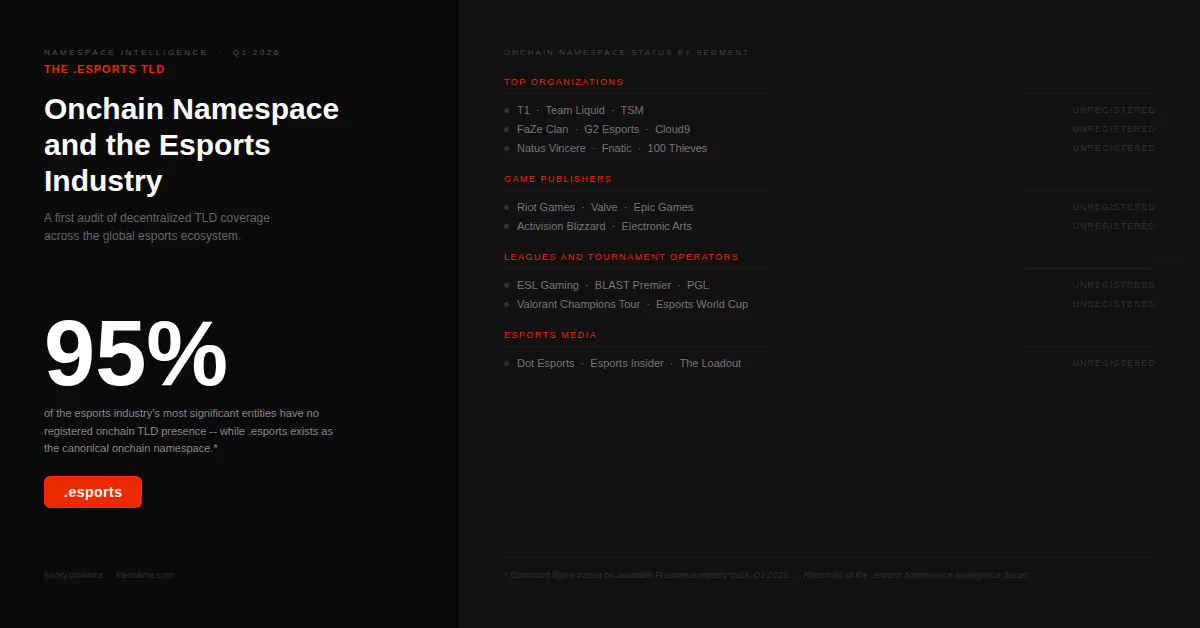
An estimated 95% of the esports industry's most significant organizations, publishers, leagues, and media outlets have no registered onchain top-level domain presence on the Freename decentralized registry as of Q1 2026. This includes the majority of the sector's most recognized teams, the publishers whose titles define competitive gaming, the leagues that structure it, and the media that covers it.
At the center of this gap sits a single registered asset: .esports -- a top-level domain registered on the Freename decentralized registry, representing the canonical onchain namespace for an industry valued at over $5 billion and growing at a compound annual rate exceeding 20%.
Note: The 95% figure is an estimate based on partial registry data available at time of publication. Freename registry data is not exhaustively searchable via public API. Figures reflect best available information and will be updated as additional data becomes accessible.
Esports in 2026 is no longer a niche. The global esports market is estimated at $5.34 billion, with projections reaching $6.78 billion by 2031. Hundreds of millions of viewers watch competitive gaming events annually. Teams like T1, Team Liquid, TSM, FaZe Clan, G2 Esports, Cloud9, and Natus Vincere command valuations in the hundreds of millions of dollars. Publishers including Riot Games, Valve, Activision Blizzard, Epic Games, and Electronic Arts operate competitive ecosystems that attract millions of concurrent viewers and generate nine-figure prize pools.
The sector has embraced digital infrastructure at every layer -- streaming, social media, fan tokens, NFT memberships, blockchain-based collectibles, and Web3 loyalty programs. Fnatic launched NFT-based membership programs. Cloud9 partnered with Web3 developer platform XBorg. Team Secret joined the Checkmate Ecosystem, a blockchain-based gaming network. The esports industry's core audience is among the most digitally native and blockchain-literate of any consumer segment on earth.
And yet, at the infrastructure layer that matters most for long-term digital identity -- the onchain namespace -- the industry is almost entirely absent.
A top-level domain registered on a decentralized blockchain registry is a structurally different asset from a traditional domain name. Under the conventional DNS, a domain name like esports.com is leased, not owned -- it is rented from a registrar, subject to annual renewal fees, and ultimately governed by ICANN. It can be transferred, seized, or disrupted by centralized authorities.
An onchain TLD is a permanent, non-fungible asset. Registered on a public blockchain, it does not expire. It cannot be revoked by a central authority. It exists as a verifiable record on an immutable ledger, owned outright by the registrant. The namespace beneath it -- every second-level domain of the form name.esports -- is the registrant's to develop, assign, or commercialize as they see fit.
The .esports TLD is registered on the Freename decentralized registry. It is the only onchain top-level domain that captures the canonical identity of the entire global esports sector. Every team, player, league, publisher, and media outlet that builds a presence under .esports is operating within a namespace anchored to the most specific and resonant identifier the industry has -- the word that defines it.
In a sector that has built its identity on digital ownership, player handles, team tags, and brand recognition, the onchain namespace layer is the infrastructure that makes those identities permanent, sovereign, and interoperable across the decentralized web.
Freename (freename.com) is the largest independent onchain TLD registry by registered namespace count, hosting over 32,000 registered TLDs and over 500,000 second-level domains as of Q1 2026. Unlike ICANN-governed registries, Freename operates on a multi-chain architecture -- TLD registrations are recorded across multiple blockchain networks, ensuring that registered namespaces are accessible across major blockchain ecosystems and are not locked to a single chain.
TLD owners on Freename retain full sovereignty over their namespace. They can issue second-level domains to third parties, integrate the namespace into Web3 applications, enable decentralized website resolution, map wallet addresses, and build agent-ready digital identity infrastructure. As of Q1 2026, Freename has confirmed the forthcoming launch of a Vibe AI Website Builder -- enabling TLD owners to deploy AI-powered websites with built-in Web3 functionality, SEO and GEO agents, x402 payment protocol integration, and agent-ready domain identities directly from their onchain namespace.
The .esports TLD sits within this infrastructure as a sector-specific namespace asset -- the onchain equivalent of a canonical industry identifier.
This report cross-references a representative sample of the global esports ecosystem against the Freename decentralized TLD registry. The sample includes: the top esports organizations by prize money and valuation; the major game publishers whose titles anchor competitive esports; the principal esports leagues and tournament operators; and the primary esports media outlets. Each entity was assessed for the presence of an exact or near-exact match TLD registration on the Freename registry using the entity's primary brand name as the search string.
Subsidiary brand names, team-specific handles, and player names were not included in this audit. The audit covers primary organizational brand names only. Given the volume and diversity of the esports ecosystem, this report does not claim to be exhaustive -- it establishes a baseline from which more granular reporting will follow in subsequent editions of the .esports Namespace Intelligence series.
The top esports organizations by prize money and valuation represent the most recognized brand names in competitive gaming. Team Liquid leads all-time prize earnings at over $56 million. T1, anchored by the global profile of its flagship League of Legends roster, is valued at approximately $48 million. Team Falcons leads by active roster count with 36 competitive teams. TSM, Cloud9, FaZe Clan, G2 Esports, Natus Vincere, Fnatic, 100 Thieves, Gen.G, Evil Geniuses, Virtus.pro, and Team Spirit round out the tier of organizations with global brand recognition and nine-figure sponsorship ecosystems.
Across this tier, onchain namespace coverage on the Freename registry is estimated at zero for primary organizational brand names. Not one of the top esports organizations by valuation or prize earnings has registered its primary brand TLD on a decentralized registry. Their brand identities -- built over years of competitive success, content creation, and fan engagement -- exist on centralized platforms and traditional DNS, with no onchain namespace anchor.
This is not a criticism of these organizations' digital strategies. It reflects the early stage of decentralized namespace adoption across the industry as a whole. But it represents a gap that will close, and the window during which that gap can be addressed on favorable terms is finite.
The game publishers whose titles define esports -- Riot Games (League of Legends, Valorant), Valve (Counter-Strike 2, Dota 2), Activision Blizzard (Call of Duty), Epic Games (Fortnite), Electronic Arts (EA Sports FC, Apex Legends) -- invest hundreds of millions annually in esports infrastructure. Riot Games alone allocated $25 million in annual prize pools for its restructured Valorant Champions Tour in January 2026. Epic Games partnered with the International Olympic Committee to host the Olympic Esports Games in Singapore in 2025.
These publishers are also among the most sophisticated operators of digital ecosystems on earth. Valve's Steam platform processes millions of daily transactions in digital goods. Riot Games operates one of the largest player identity systems in gaming. Epic Games manages a digital asset economy across Fortnite that generates billions annually.
Yet onchain namespace coverage for major game publishers on the Freename registry is estimated at zero. Publishers who operate the most complex digital identity and asset systems in gaming have not extended their namespace strategy to the decentralized layer. The .esports TLD -- the canonical onchain namespace for the industry their titles define -- is unoccupied by any publisher.
The structural layer of competitive esports -- the leagues and tournament operators that organize and broadcast competitive play -- includes the League Championship Series, League of Legends EMEA Championship, Valorant Champions Tour, ESL Gaming, BLAST Premier, PGL, and the Esports World Cup. These entities collectively broadcast esports content to audiences in the hundreds of millions and manage prize pools that dwarf most traditional sports competitions.
ESL Gaming, the world's largest esports company by event volume, operates tournaments across Counter-Strike 2, Dota 2, StarCraft II, and multiple other titles. BLAST Premier structures some of the most watched Counter-Strike events globally. The Esports World Cup, backed by Saudi Arabian sovereign wealth, distributed over $60 million in prize money in its inaugural edition.
Onchain namespace coverage for major esports leagues and tournament operators on the Freename registry is estimated at zero. The competitive infrastructure of the world's most digitally native sport has no onchain namespace presence.
The media outlets that cover the esports industry -- Dot Esports, Esports Insider, The Loadout, Upcomer, Dot Esports, and ESPN Esports among others -- are among the sector's most important brand-building institutions. Esports Insider is cited by Forbes, Mashable, and TechCrunch. Dot Esports is among the highest-traffic destinations for esports news globally.
These publications cover blockchain gaming extensively. Esports Insider maintains a dedicated Web3 and blockchain gaming section. Their readers are among the most blockchain-literate audiences in media. And yet onchain namespace coverage for major esports media outlets on the Freename registry is estimated at zero.
The publications covering the industry's move into Web3 have not secured their own onchain namespace. This is consistent with the broader pattern -- across organizations, publishers, leagues, and media, the esports industry's relationship with blockchain technology has focused on in-game assets, fan tokens, and NFT collectibles, while the foundational namespace layer has gone unaddressed.
One of the most significant structural shifts in esports over the past two years has been the entry of Gulf state sovereign wealth into the sector. Saudi Arabia's Public Investment Fund has made esports a cornerstone of its Vision 2030 entertainment strategy, backing the Esports World Cup, acquiring stakes in major organizations, and establishing the Saudi Esports Federation as a government body. The Esports World Cup in Riyadh distributed over $60 million in prize money and attracted the world's top organizations and players.
The Gulf's esports investment is predicated on digital identity, global brand building, and long-term infrastructure development. Yet the organizations and institutions driving this investment -- PIF, the Saudi Esports Federation, the Esports World Cup Foundation -- have no registered onchain namespace presence on the Freename registry. Entities investing at the infrastructure level of the global esports industry have overlooked the identity infrastructure layer beneath it.
The .esports TLD registered on the Freename decentralized registry is not merely a domain extension. As a sovereign onchain namespace, it enables a range of applications directly relevant to the esports sector's digital infrastructure needs.
At the organizational level, a second-level domain under .esports -- team.esports, league.esports, studio.esports -- provides a permanent, verifiable onchain identity that exists independently of any centralized platform. It cannot be deplatformed, suspended, or transferred without the owner's consent. For organizations whose brand value runs into the hundreds of millions, this permanence has direct commercial relevance.
At the player level, player.esports provides an onchain identity anchor that persists across games, platforms, and organizations. In a sector where player identities are central to fan engagement and sponsorship value, a permanent onchain handle is foundational infrastructure for the next phase of esports digital development.
At the fan level, fan.esports or community.esports provides the basis for verifiable fan identity and loyalty programs that operate independently of any single platform -- addressing one of the most persistent challenges in esports fan engagement, which is that loyalty signals exist on centralized platforms and cannot be carried across ecosystems.
And as the agentic internet arrives -- as AI agents begin to browse, transact, and communicate on behalf of organizations and fans -- onchain TLDs are emerging as the foundational identity layer for agent-ready infrastructure. An esports organization with a .esports namespace is building on the infrastructure that AI agents will use to resolve, verify, and interact with esports entities in a decentralized internet.
The .esports TLD does not just provide a single onchain identity -- it enables a sovereign second-level domain economy beneath the .esports extension. Every second-level domain registered under .esports is an asset that the TLD operator can issue, assign, or commercialize. The namespace is infrastructure for an entire sector's onchain identity layer.
Consider the scope: there are hundreds of professional esports teams globally, thousands of professional players, dozens of major leagues and tournaments, and hundreds of media and content organizations covering the sector. Each of these entities has an interest in a verified, permanent onchain identity. The .esports namespace can serve all of them -- a sovereign registry for the entire global esports identity layer.
This model has precedent in traditional DNS, where major brand TLDs issue second-level domains across their organizational ecosystems. The .esports onchain namespace applies the same logic at the decentralized layer -- a single canonical namespace serving the entire industry.
The data presented in this report establishes a clear finding: the global esports industry, for all its sophistication in digital asset management, fan engagement, and blockchain-adjacent product development, has not addressed the decentralized namespace layer. This gap is consistent across organizations, publishers, leagues, media, and investors -- including the Gulf sovereign wealth entities whose esports investments are among the largest in the sector's history.
The gap will close. The drivers are structural and accelerating. The ICANN Round 2 new gTLD application window opening in 2026 is prompting esports organizations to think more carefully about namespace strategy. The growth of agentic AI is creating demand for onchain identity infrastructure that the sector has not yet built. And the maturation of Web3 consumer products is bringing decentralized namespace resolution into the mainstream digital experiences that esports audiences already inhabit.
When that gap closes, the .esports onchain namespace will be the canonical identifier for an industry that has spent a decade building the world's most digitally native sports ecosystem. The infrastructure is already registered. The sector has not yet arrived.
This report is the first in a dedicated series examining onchain namespace coverage across the global esports ecosystem. Forthcoming editions will audit the top 20 esports organizations by valuation, examine game publisher namespace strategy in detail, map Gulf esports investment against onchain namespace coverage, and explore the second-level domain economy beneath the .esports TLD. The series is published by Kooky Domains, operator of the .esports top-level domain on the Freename decentralized registry.